

Per-/PolyfluoroAlkyl Substances (PFAS)
are a group of thousands of mainly man-made substances that are used in numerous applications in EU. Being used globally since the 1940s, PFASs have already caused contamination around the world.
Currently PFASs chemical class encompass around 10,000 congeners widely used in
- textiles,
- (food) packaging,
- lubricants,
- refrigerants,
- electronics,
- construction and
- many more industries including pharmaceutical and medical ones.
Because of the duration and breadth of use, PFASs can be found in surface water, groundwater, soil, and air – from remote rural areas to densely-populated urban centres. The concern regarding PFAS is based on environmental and health considerations. The continued use of PFAS in the various applications is estimated to result in about 4.5 million tonnes of emissions to the environment in the EU over the next 30 years (2025-2055) unless action is taken. This estimate covers only the use phase, and is therefore a severe underestimation of the true emissions likely to be expected.
Timeline
In March 2023, ECHA published the ‘Annex XV Restriction Report: Proposal for a Restriction of per- and polyfluoroalkyl substances (PFAS)’ focusing on the risks to the environment and human health associated with the use of PFAS. The restriction was scheduled to come into force in mid-2025 with a transition period of 18 months until the end of 2026. The process was slowed down by numerous comments (> 5600) from industry. In December 2025, the Annex XV dossier was updated and the RAC decision was made. The dossier is currently with the ECHA’s Scientific Committee for Socio-economic Analysis (SEAC) for comment.
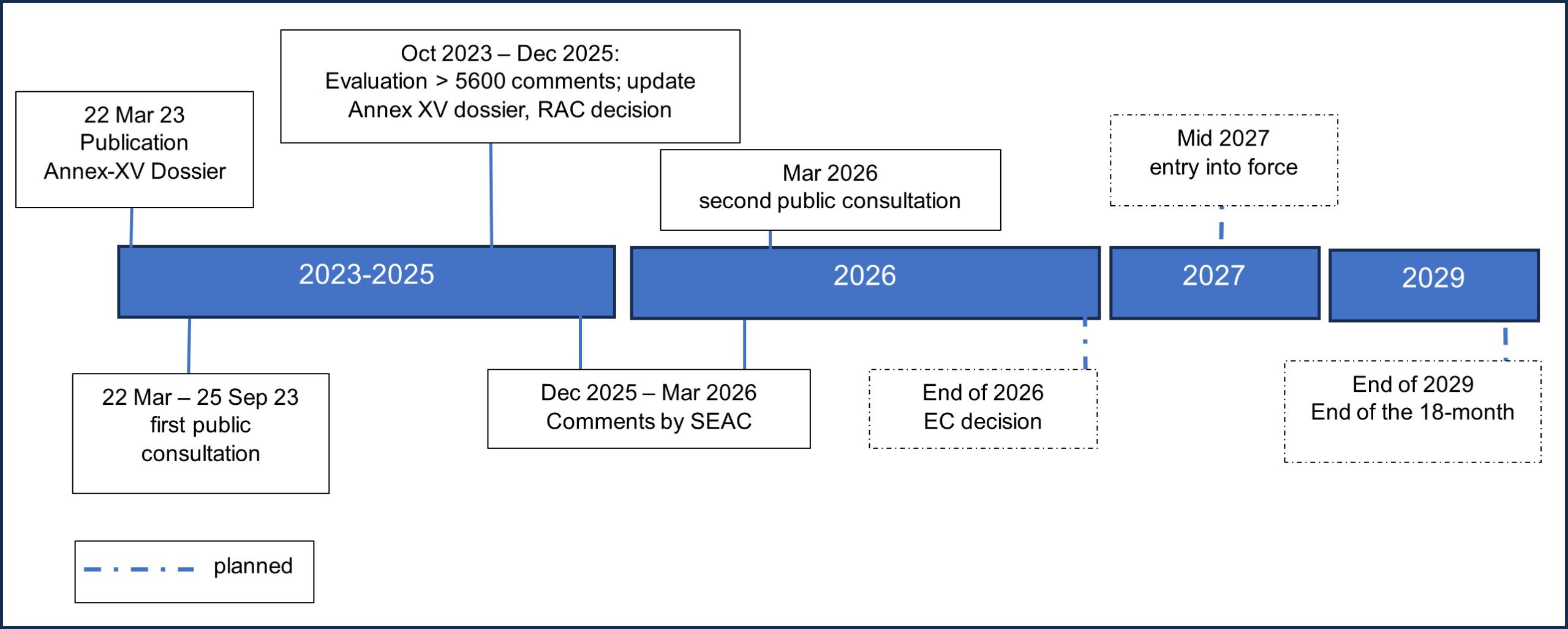
The SEAC’s decision is now expected in March 2026. This will be followed by a second public consultation on the authority’s new ECHA Survey Tool, which will last 60 days. Within six months of the end of the consultation, the European Commission’s decision should be available and the restriction in accordance with the Annex XV dossier should come into force. The 18-month transition period would expire at the end of 2029. For medical devices, the final ban on the use of PFAS would come into force after 12 years in 2041.
In 2024, the opinion of the ECHA committee on the restriction options with regard to the public consultation was expected; the Implementing Regulation on restriction of PFASs of the European Commission (EC) was planned to enter into force in 2025 (see figure below).
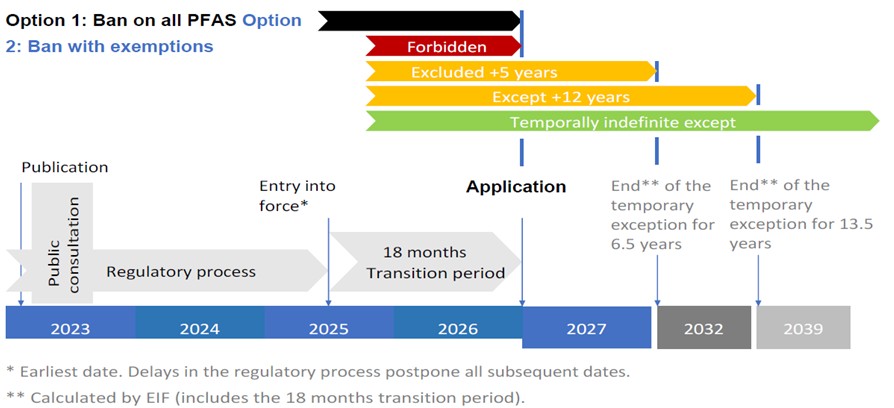
Figure: Timeline of the proposed regulatory process on PFASs, if total ban is avoided (ECHA 2023)
| Sector/Topic | RAC | SEAC |
| Hazard of PFAS | Discussion: 03/2024, 06/2024 Provisional conclusion: 06/2024 |
— |
| General approach to emissions estimation (including waste) | Discussion: 06/2024, 09/2024 | — |
| General approach to socio-economic analysis | — | Discussion: 03/2024, 06/2024 to be continued |
| Consumer mixtures, cosmetics and ski wax | Discussion: 03/2024, 06/2024 Provisional conclusion: 06/2024 |
Discussion: 03/2024 Provisional conclusion: 06/2024 |
| Metal platin | Discussion: 06/2024 Provisional conclusion: 06/2024 |
Discussion: 06/2024 Provisional conclusion: 06/2024 |
| Petroleum and mining | Discussion: 09/2024 Provisional conclusion: 09/2024 |
Discussion: 09/2024 Provisional conclusion: 09/2024 |
| Textiles, upholstery, leather, apparel, carpets (TULAC) | Discussion: 09/2024, 11/2024 Provisional conclusion: 11/2024 |
Discussion: 09/2024, 11/2024 Provisional conclusion: 11/2024 |
| Food contact materials and packaging |
Discussion: 09/2024, 11/2024 Provisional conclusion: 11/2024 |
Discussion: 09/2024, 11/2024 Provisional conclusion: 11/2024 |
| Construction products | Discussion: 11/2024 Provisional conclusion: 11/2024 |
Discussion: 11/2024 Provisional conclusion: 11/2024 |